


Ammonia Temperature-Programmed Desorption (NH3-TPD)
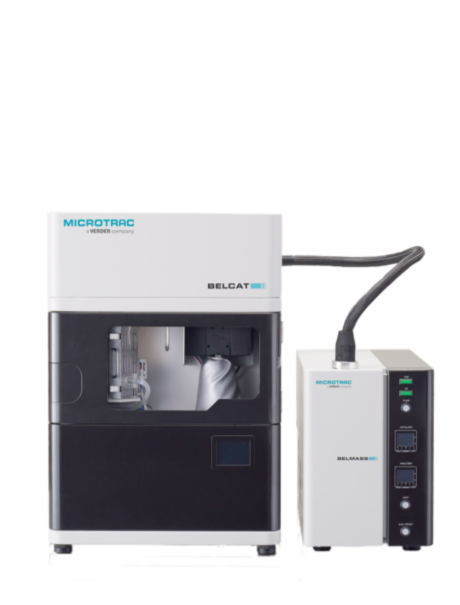
Purpose & Applications
Ammonia temperature-programmed desorption (NH3-TPD) is a widely used technique for characterising the acidity of material surfaces, including the amount of acid sites, acid strength distribution, and acidity features. By monitoring the desorption behaviour of ammonia during programmed heating, it provides valuable insight into surface acidity and supports studies of acid-catalysed reaction mechanisms, active-site analysis, and catalyst structure optimisation. The technique is broadly applicable to zeolites, metal oxides, supported catalysts, solid acid catalysts, and other porous functional materials, and is widely used for acidity characterisation, comparison of acidity changes after material modification, structure–activity correlation, and catalyst screening and optimisation.
Instrument Model
Microtrac:Belcat II
Sample Requirements
1 | Sample Type
Suitable for powdered or granular solid catalysts with measurable surface acidity, such as zeolites, metal oxides, supported catalysts, and solid acid materials.2 | Sample Amount
A sample amount of 100–300 mg is generally recommended. For materials with weaker acidity or fewer active sites, a larger amount may be required.3 | Particle Size
Samples should have a relatively uniform particle size and should be free of significant agglomeration or large particles to ensure consistent adsorption–desorption behaviour and good test reproducibility.4 | Sample Condition
Samples should be dry, clean, moisture-free, and uncontaminated. For materials that are sensitive to moisture, CO₂, or other impurities, sealed storage is recommended, and storage conditions should be noted before testing.5 | Thermal Stability
As the test involves programmed heating, samples should have sufficient thermal stability. If decomposition, phase transition, or volatilisation may occur during heating, this should be stated in advance.
