


In situ electrocatalytic DRIFTS
Purpose & Applications
In situ electrocatalytic infrared spectroscopy is an important characterisation technique for investigating electrochemical interfacial processes. It enables real-time monitoring of the dynamic evolution of species on the electrode surface, allowing qualitative analysis of adsorbed intermediates and products as well as their response to changes in applied potential. The technique is primarily based on ATR / SEIRAS configurations, where surface-enhanced infrared absorption significantly improves the sensitivity toward interfacial species. It is widely used in electrocatalytic mechanistic studies, kinetic analysis, electrode interface investigation, and electrocatalyst performance evaluation.
Instrument Model
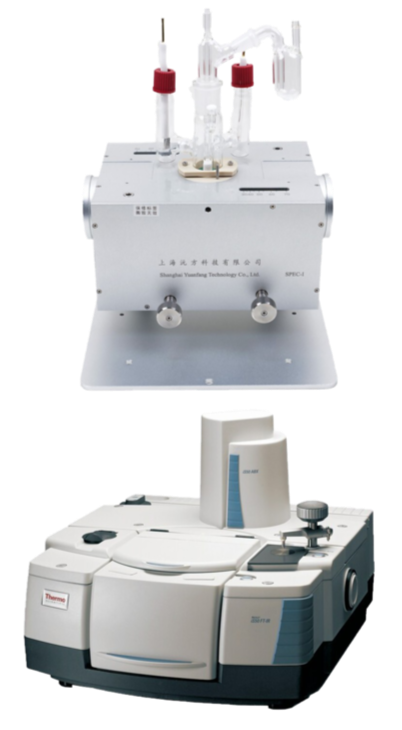
In Situ Electrocatalytic Cell (Shanghai Yuanfang): Kretschmann-Type ATR-SEIRAS
FTIR Spectrometer (Thermo Fisher Scientific): Nicolet iS50
Sample Requirements
1 | Sample Type
Suitable for electrocatalytic materials that can be integrated into an ATR / SEIRAS working electrode system, including metals, metal oxides, supported catalysts, and other electrocatalytically active materials. Samples are typically loaded onto the enhanced substrate surface by drop-casting or electrodeposition.2 | Substrate Requirements
Testing is typically carried out using an internal reflection enhancement structure based on a single-crystal silicon substrate coated with a nanostructured gold film. The gold nanofilm should provide good electrical conductivity and strong surface-enhanced infrared response to meet the requirements of in situ measurements.3 | Sample Loading Requirements
The catalyst should be able to adhere stably to the electrode surface and form a working electrode suitable for in situ testing. Uniform sample dispersion and a stable loading layer are recommended to avoid detachment or uneven coverage during measurement.
